





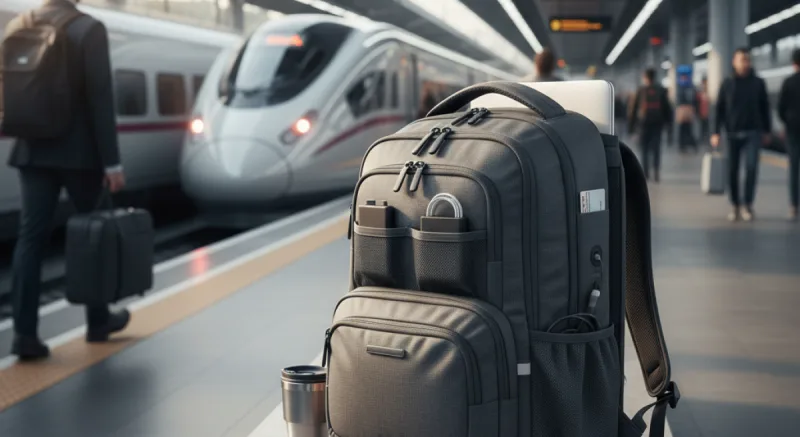


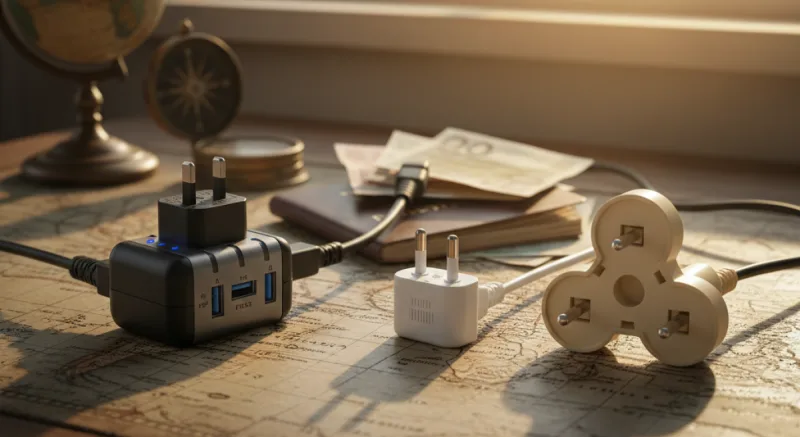
A tech pouch is a small bag for the things that otherwise tangle at the bottom of your backpack: chargers, cables, earbuds, a power bank, adapters. They are cheap compared with the gear inside them, and the right one saves you a minute of digging every day.
Start with a list, not a product page. Lay out what you actually carry and count it. Most daily kits fit in about one to two liters. A travel kit with a laptop charger, a multi-port adapter and a power bank needs two liters or more. Buying a pouch first and filling it second is how you end up carrying three spare cables you never use.
Then pick a shape. Flat pouches slide into a laptop sleeve or a document pocket. Clamshell pouches open fully like a book, so you can see everything at once, which matters when you are looking for one cable in an airport. Structured pouches with some padding protect a power bank or a pair of earbuds better than a soft sack.
Inside, look at how the space is divided. Elastic loops hold cables neatly but only in the sizes they were sewn for. Mesh pockets flex around odd shapes. Folded pockets that expand as you fill them use space best but take a moment to learn.
A few details are worth having: a zipper that opens the pouch fully, a pass-through so a power bank can charge a phone while zipped in, a grab handle, and a light interior color so a black cable does not vanish into a black lining.
Three well-known pouches show the price range. The Peak Design Tech Pouch is two liters with origami-style folded pockets, a cable pass-through and a weatherproof recycled nylon shell, and sells for about $60. The Aer Cable Kit 3 lists at $59, with an X-Pac version at $79. The Bellroy Tech Kit is a zip pouch for a power bank, charger, cables and earbuds, listed at $59.
One rule if you fly: a power bank counts as a spare lithium battery, so the pouch holding it goes in your carry-on, never your checked bag.
The short version: count what you carry, buy a pouch one size up, prefer one that opens fully, and expect to pay about $60 for a good one.