






Docker solves an old problem: software that works on one machine and breaks on another because of a different library version, a missing package or a changed setting. It packages an application together with everything it needs, so it runs the same way on your laptop, a colleague's laptop and a production server.
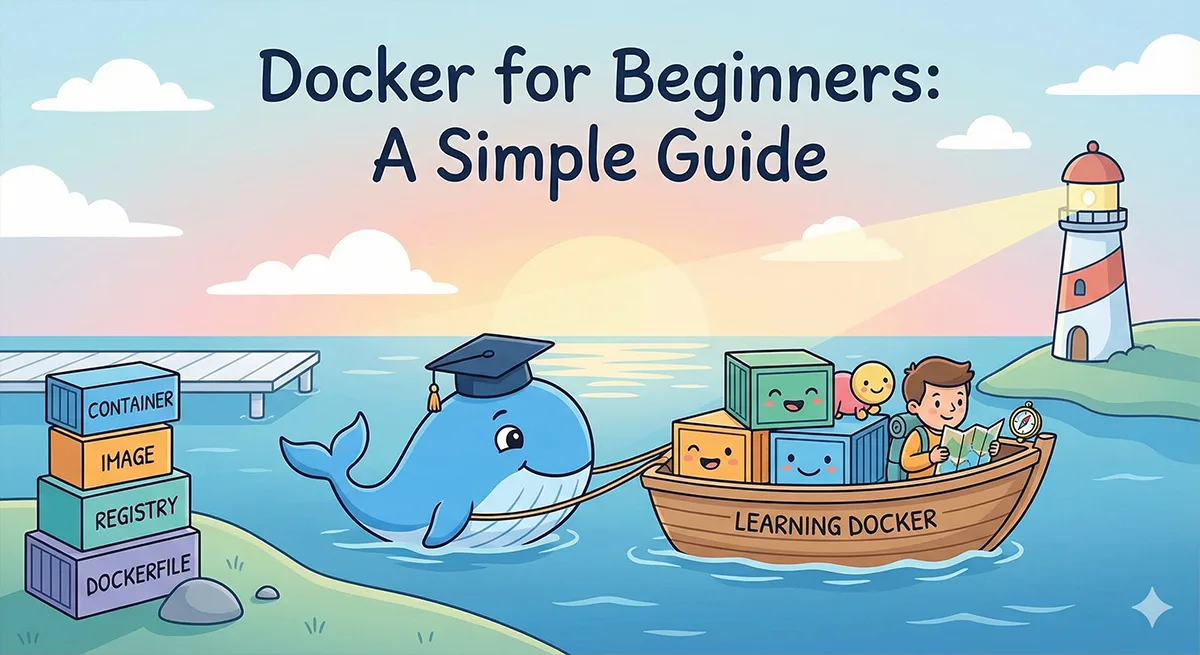
Four words cover most of it. An image is a read-only template: an operating system base, your code and its dependencies. A container is a running copy of an image, isolated from the rest of the machine. A Dockerfile is a short text file of instructions for building an image. A registry, such as Docker Hub, is where images are stored and shared.
Containers are not virtual machines. A virtual machine runs a whole separate operating system. A container shares the host's kernel and only packages what sits on top of it. That is why containers start in seconds and a single server can run dozens of them.
A typical Dockerfile is only a few lines. It starts from a base image, such as an official PHP, Node or Python image, copies your code in, installs dependencies and states the command to run. You build it into an image once, then start as many containers from it as you need.
Containers are disposable by design. When one is removed, anything written inside it is gone. Data that must survive, such as a database's files or uploaded images, belongs in a volume, which is storage that lives outside the container.
Most real projects need more than one container: an app, a database, perhaps a cache. Docker Compose describes all of them in one YAML file and starts them together with a single command. For local development, that alone is worth learning Docker for. A new developer runs one command instead of following a page of setup notes.
On Windows and macOS you would normally install Docker Desktop. It is free for personal use, education and small businesses with fewer than 250 employees and less than $10 million in annual revenue. Larger companies need a paid subscription. On Linux, Docker Engine runs natively.
The short version: learn images, containers, Dockerfiles and volumes, then Docker Compose. Start by containerizing one small project with its database, and the concepts will click faster than any tutorial can make them.